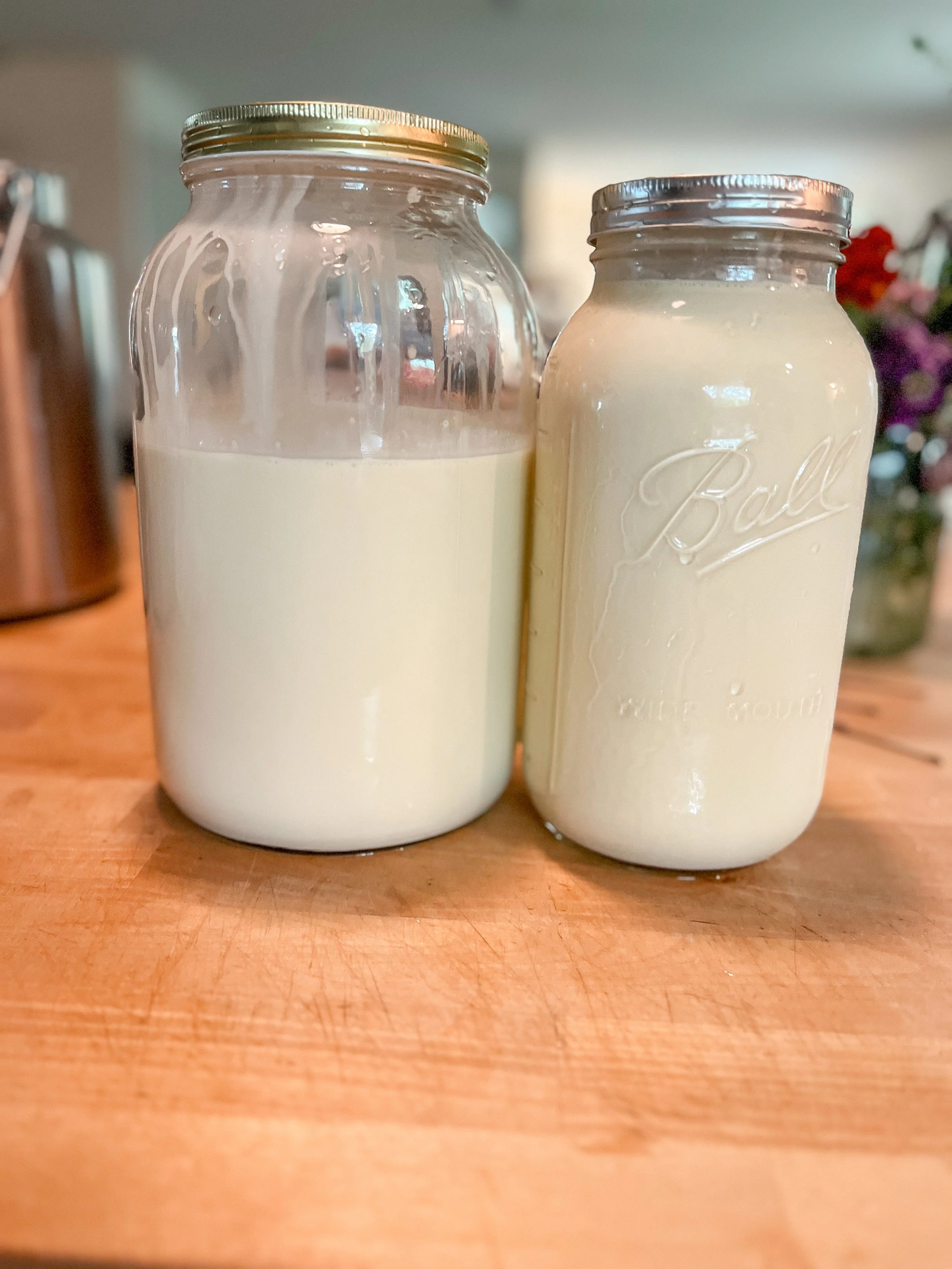
If you’ve ever opened a jar of fresh milk and found a beautiful layer of cream sitting right at the top, you’ve seen something that used to be perfectly ordinary in the American kitchen.
Before milk was routinely homogenized, families knew to give their milk a little shake before pouring—or, if they were lucky, skim a little cream off the top for their coffee, cooking, or a batch of homemade whipped cream.
Today, many people are surprised to see that layer of cream. Some even wonder if something is wrong with their milk!
But that cream line is not a mistake. It’s simply what milk naturally does when it hasn’t been homogenized.
At Rose n’ Thistle Farm, we appreciate the simple things about traditional food, and this is one of them. Let’s take a closer look at what’s happening inside that jar.
First, what exactly is homogenization?
Milk is made up of several wonderful things, including water, proteins, minerals, lactose, and fat.
That milk fat naturally exists in tiny droplets called milk fat globules. These globules are surrounded by a delicate structure known as the milk fat globule membrane. This membrane contains various fats, proteins, and other compounds that naturally surround and protect the fat.
Because fat is lighter than water, those fat globules gradually rise toward the surface when milk is left undisturbed.
That’s why cream rises to the top!
Homogenization is a mechanical process used by most commercial dairies to prevent this natural separation. Milk is pushed through very small openings under pressure, breaking the fat globules into much smaller droplets. These smaller droplets remain more evenly distributed throughout the milk instead of gathering into a layer of cream.
The result is the familiar, consistently white milk that looks the same from the first pour to the last.
Homogenization doesn’t remove the cream. It changes the size and structure of the fat droplets so the cream stays dispersed.
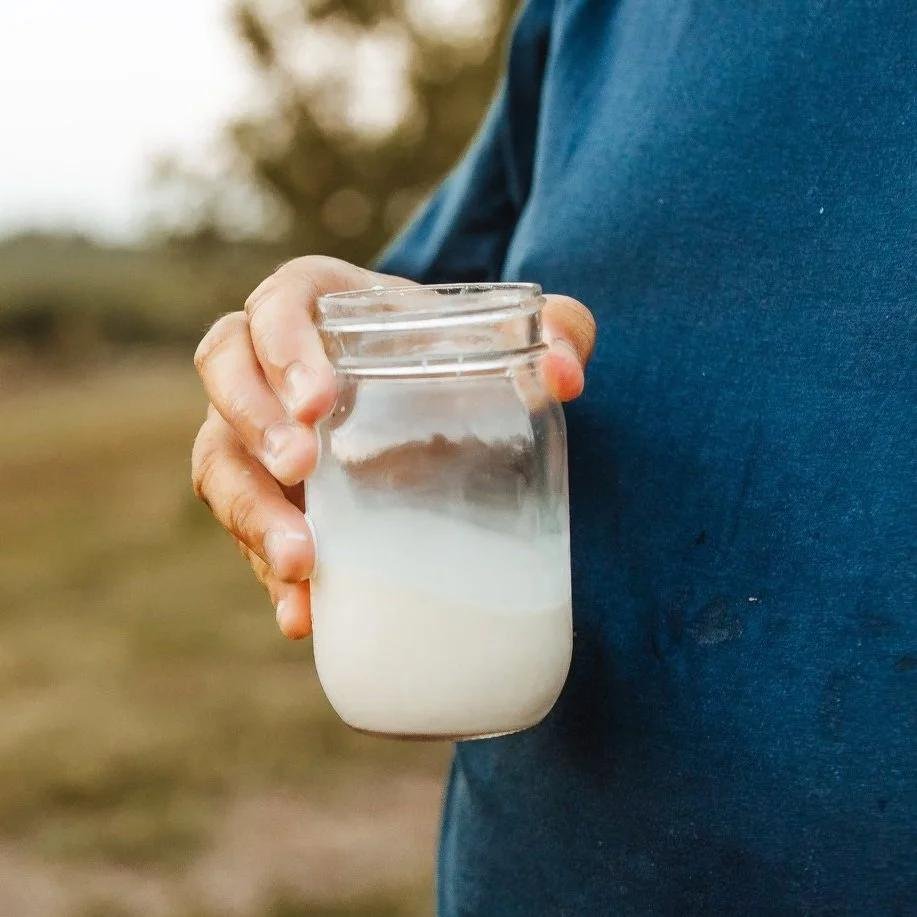
What is the difference between homogenized and non-homogenized milk?
The simplest difference is what happens when you let the milk sit.
Homogenized milk:
The fat droplets have been mechanically reduced in size.
The cream stays evenly distributed.
You won’t see a natural cream line form at the top.
Non-homogenized milk:
The fat globules remain much closer to their natural size and structure.
The cream gradually rises to the top.
You can see and use the cream separately.
Neither type of milk has had its cream removed simply because it has or hasn’t been homogenized. The difference is how that cream is distributed.
And if you’ve ever wondered why one jar has a thicker cream line than another, the natural butterfat content can vary. Cow, breed, stage of lactation, season, and feed can all influence milk composition.
Our Jersey cows are known for producing particularly rich milk, which is one reason we love having Jerseys in our little dairy herd.
Why do some families prefer non-homogenized milk?
For many families who value traditional foods, the appeal of non-homogenized milk is fairly simple: they prefer food that has undergone less mechanical alteration.
For generations, milk was consumed with its cream naturally rising to the top. Families used that cream in their kitchens, made butter, and incorporated fresh dairy into everyday meals.
There is also an interesting area of modern research behind this preference.
Scientists have been studying the milk fat globule membrane, or MFGM. This natural membrane contains phospholipids, proteins, and other compounds that are part of the structure surrounding milk fat.
Homogenization changes that structure. Research has shown that when fat globules are broken into smaller droplets, some of the original membrane is disrupted and milk proteins become associated with the newly formed surfaces.
That doesn’t mean researchers have proven that non-homogenized milk prevents disease, improves digestion, or is healthier for everyone. Those are much bigger claims than the current evidence supports.
But it does mean that the physical structure of milk matters, and scientists are still studying what those differences may mean for digestion and nutrition.
From a traditional-food perspective, we appreciate that milk comes with its own natural structure, and we like the idea of leaving more of that structure intact.
Is homogenization the same as pasteurization?
No! This is an important distinction.
These two processes serve different purposes.
Homogenization is a mechanical process that changes the size of milk fat globules to keep cream from separating.
Pasteurization is a heat treatment intended to reduce harmful microorganisms in milk.
Milk can be homogenized and pasteurized, pasteurized without being homogenized, or processed in other ways. One process does not automatically mean the other has occurred.
It’s worth understanding the difference rather than assuming that all milk processing is the same.
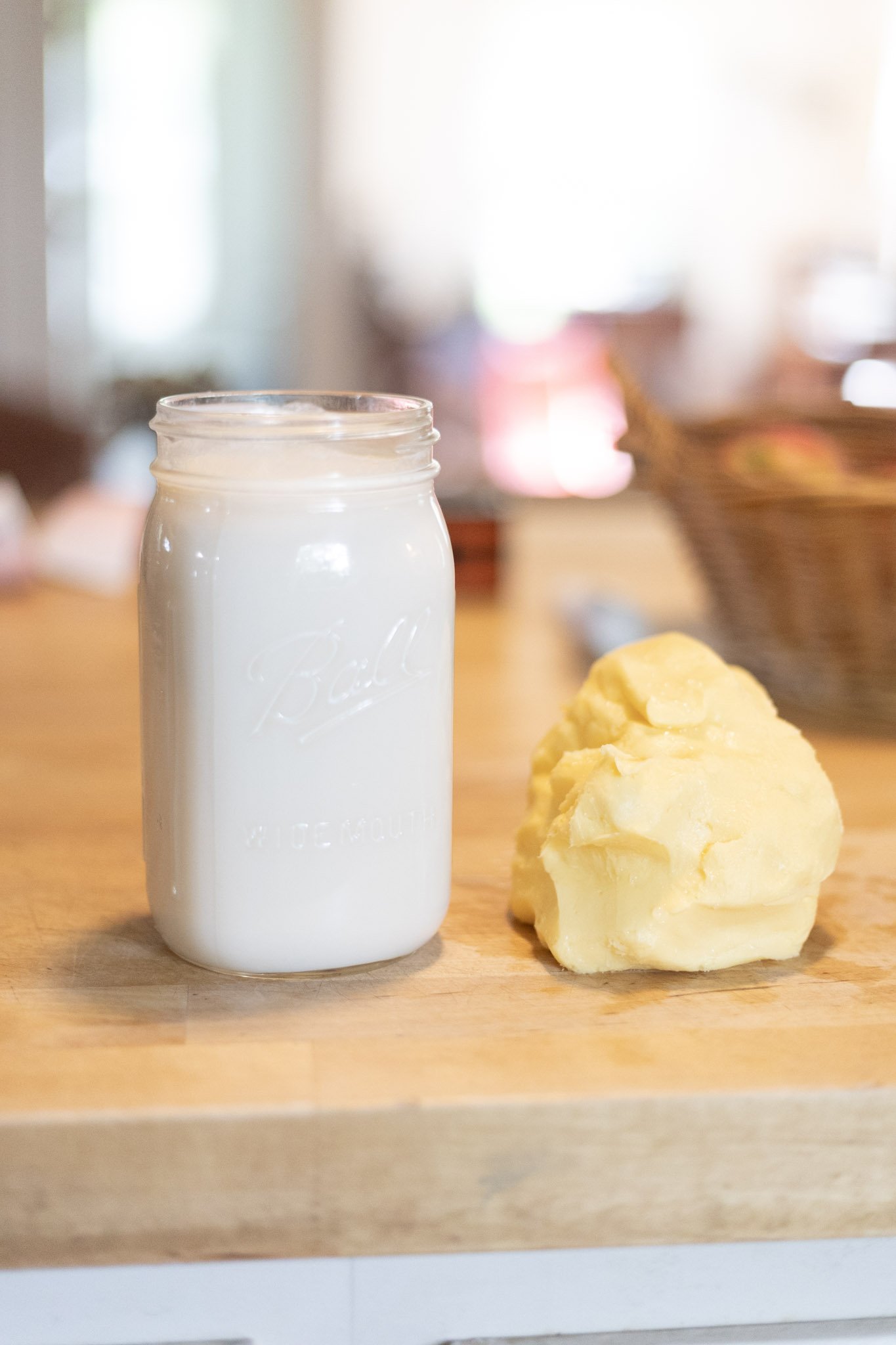
What can you do with that cream on top?
This might be my favorite part!
That layer of cream isn’t something you need to pour off and throw away. It’s a wonderful ingredient to have in your kitchen.
Here are a few ways to use it:
Coffee: Add a splash of rich cream to your morning cup.
Whipped cream: Whip chilled cream with a little sweetener and vanilla.
Homemade butter: With enough cream, you can make your own butter right in your kitchen.
Cooking: Use cream in soups, sauces, mashed potatoes, and other family favorites.
Desserts: Add it to custards, ice cream, and homemade treats.
And don’t forget: if you’d rather have the cream mixed back into your milk, simply give the jar a gentle shake.
A little reminder from our farm

We think there’s something special about food that reminds us where it came from.
A cream line in a jar of milk is a small thing, but it tells a story. It reminds us that milk comes from a cow, not a factory, and that sometimes the things we have grown accustomed to seeing in the grocery store aren’t the only way food can be.
At Rose n’ Thistle Farm, we’re grateful for the opportunity to raise our Jersey cows and share a little piece of traditional farm life with our community.
So the next time you open a jar and see that cream sitting on top, don’t worry. Give it a shake, save a little for your coffee, or make something wonderful with it.
That’s not a flaw in your milk. It’s part of Gods good design.
From our farm to your kitchen,
Millie
Rose n’ Thistle Farm